Confused by all the dog food options? Learn how to choose the right food based on your dog’s age, size, body condition, activity and health—with practical buying tips for pet parents in Nepal.
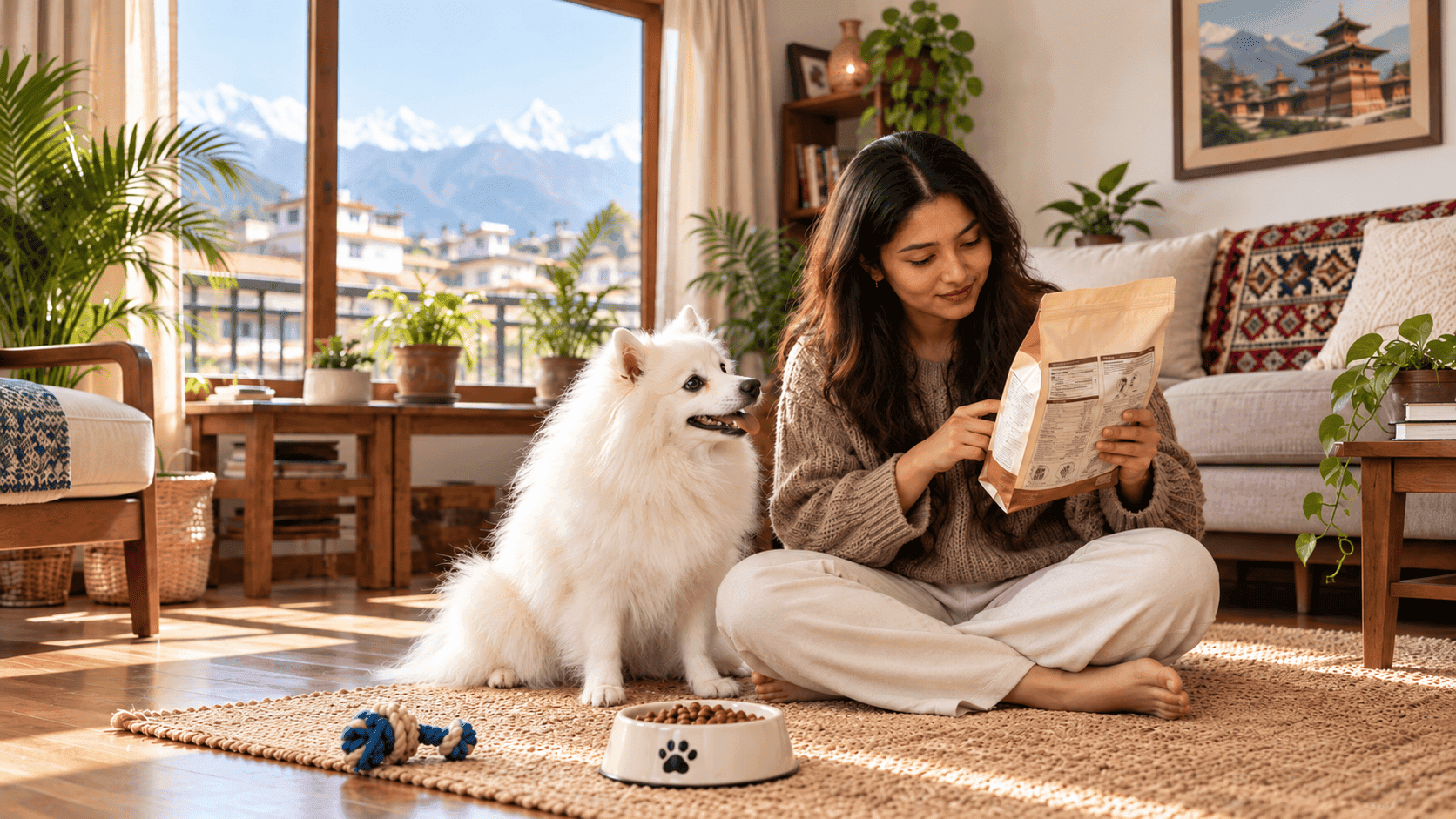
Choosing dog food should be simple.
But once you start comparing bags, it usually isn’t.
Puppy or adult? Chicken or lamb? Small breed or large breed? Dry or wet? Grain-free? High-protein? Premium?
There are plenty of options, and the front of every pack seems to give you another reason to choose it.
So where should you actually start?
Start with your dog—not the brand.
The right food should match your dog’s life stage, size, body condition, activity level and health needs, while providing appropriate nutrition for everyday feeding.
Here’s what I would check before choosing a food for a dog.
Before looking at ingredients or comparing brands, ask:
How old is my dog?
Is my dog still growing?
What size will they be as an adult?
Are they very active or mostly indoors?
Are they lean, at an ideal weight or gaining excess weight?
Do they have any ongoing health concerns?
These questions matter more than whether the pack says “premium.”
Puppies need food formulated to support growth.
And if you have a large or giant-breed puppy, choosing an appropriate growth diet becomes particularly important.
Large dogs grow for longer than smaller dogs, and excessive energy intake during growth is not desirable. They should stay lean while growing rather than being encouraged to grow as quickly as possible.
So a six-month-old puppy that already looks big may still need puppy food.
For most healthy adults, the goal is simpler:
maintain a healthy body condition.
A very active dog may need more energy than a dog of the same weight that spends most of the day indoors.
Don't automatically switch food just because your dog reaches a particular birthday.
There is no single nutritional requirement that applies to every senior dog. One may gain weight as activity decreases, while another may lose muscle or develop a medical condition that changes their nutritional needs.
Look at the individual dog, not just the age printed on the calendar.
This sounds obvious, but it is easy to overlook.
Not everything sold for dogs is designed to provide their entire daily diet.
You may also find:
treats
toppers
supplements
complementary foods
These can have a place in feeding, but they should not automatically replace a nutritionally complete everyday diet.
When comparing foods, look for information showing what life stage the food is intended for and whether it is designed to provide complete nutrition.
That matters much more than an attractive picture on the front.
A common question is:
“Chicken is the first ingredient. Does that mean this food is better?”
Not necessarily.
Ingredient lists can be useful, but they do not tell you everything about the nutritional quality of the finished food.
What matters is the whole formulation and whether it provides appropriate nutrients for the dog eating it.
So rather than deciding from one ingredient, ask:
Is this diet appropriate for my dog’s life stage and needs?
That is a much more useful question.
Pet-food packs often use words such as:
Premium. Natural. High-protein. Holistic. Grain-free. Breed-specific.
These may describe certain characteristics of a product, but none of them automatically means:
“This is the best food for my dog.”
The same is true for price.
The most expensive bag in the shop is not necessarily the most suitable one.
Look beyond the headline on the pack.
Useful things to check include:
who makes the food
which life stage it is intended for
nutritional information
feeding guidance
manufacturer contact information
whether the company clearly explains its products
A food company should ideally be able to tell you more than what fits on the front of the bag.
Imagine two dogs.
Both weigh 20 kg.
One walks twice a day, plays constantly and stays lean.
The other spends most of the day indoors and has already started gaining extra body fat.
Should they automatically eat the same amount?
Probably not.
Feeding needs can vary with activity, age, body condition, treats and individual metabolism.
That is why the number printed on a feeding chart should usually be treated as a starting point, not a perfect amount for every dog.
Then watch your dog.
In many dogs at an ideal body condition:
the ribs can be felt without a thick layer of fat covering them
a waist can be seen from above
there is an abdominal tuck when viewed from the side
If you're unsure what your dog's body condition is, ask a veterinary professional to assess it.
AAHA recommends considering body condition and muscle condition as part of nutritional assessment rather than relying on body weight alone.
This is another question pet parents ask frequently.
The simple answer:
either can work.
A nutritionally appropriate dry food can be suitable.
A nutritionally appropriate wet food can also be suitable.
The better choice may depend on:
your dog's preference
calorie requirements
chewing ability
feeding routine
storage
budget
any medical considerations
Some dogs also eat both.
Just remember that wet and dry foods both contribute calories.
If your dog already receives a full daily portion of dry food and you regularly add wet food, treats and table food on top, the total intake can increase quite quickly.
You do not need to choose grain-free simply because it sounds healthier.
The relationship between diet and non-hereditary dilated cardiomyopathy (DCM) in dogs is still considered complex. The FDA has reported that factors may include diet formulation, ingredients, processing, genetics and underlying health—not simply whether a food contains grains.
So don't think:
grain-free = automatically better
or
grain-containing = automatically worse.
Look at the whole diet.
If your dog needs a restricted or specialized diet for a medical reason, that decision is better made with veterinary guidance.
You can learn a lot from the label.
But eventually, you also need to look at the dog.
Once your dog has adjusted to a food, pay attention to:
appetite
stool quality
body weight
body condition
energy level
muscle condition
skin and coat
repeated digestive problems
If your dog is healthy, maintaining an appropriate body condition and doing well on a nutritionally suitable food, you do not need to keep changing foods because another brand suddenly looks more exciting.
Sometimes the food that consistently works well for your dog is already the right choice.
Found a food that seems more appropriate?
Avoid replacing the whole bowl overnight unless your veterinarian has specifically advised otherwise.
A gradual transition is usually easier on the digestive system.
For many healthy dogs, you can gradually increase the new food while reducing the old food over several days.
AAHA notes that making dietary adjustments over approximately 4–7 days may help reduce gastrointestinal problems during a food change.
Some dogs may need a slower transition.
If your dog develops persistent vomiting, diarrhoea, poor appetite or another significant change, don't keep switching foods trying to solve it yourself.
That is the point to get veterinary advice.
Nutrition matters.
But when buying pet food in Nepal, I would also pay attention to the actual product in front of me.
Especially with imported foods.
A brand may have many different formulas that look very similar.
Before buying, confirm:
puppy or adult
breed size, where relevant
exact formulation
pack size
Don't buy only by recognizing the brand colour.
Especially before buying a large bag.
There is little benefit in saving money on a bigger pack if your dog will not finish it appropriately after opening.
I would avoid a pack that is:
torn
punctured
wet
badly damaged
poorly resealed
unusually swollen
The food inside matters, but so does how it has been handled.
Where available, look for clear information about who manufactured the product and who imported or distributed it.
If the sourcing of an unfamiliar product is completely unclear, I would be more cautious.
Pet food should be protected from excess heat, moisture, air and pests.
Once you open dry food, keep it properly sealed and follow the storage instructions provided by the manufacturer.
Discounts happen.
That doesn't automatically mean there is a problem.
But if a normally expensive imported food suddenly appears at a very low price, take another minute to check:
expiry
seal
packaging
seller
product condition
importer/distributor details where available
A cheap bag is not a good deal if there is uncertainty about what your dog is eating.
For a healthy dog, choosing an everyday food does not need to become complicated.
But I would be more careful if your dog has:
repeated vomiting
persistent diarrhoea
unexplained weight loss
difficulty maintaining weight
significant excess weight
poor appetite
recurring skin or digestive problems
suspected food reactions
a diagnosed medical condition
In these cases, choosing another bag from the shelf may not address the real problem.
Diet can be part of treatment, but first you need to understand what you are treating.
If you remember nothing else from this guide, check these six things:
1. Is it right for my dog's life stage?
2. Is it intended to provide complete everyday nutrition?
3. Does it suit my dog's size, activity and body condition?
4. Is the manufacturer/product information clear?
5. Is the pack in good condition and within date?
6. Is my dog actually doing well on this food?
That is already a better way to choose food than deciding from the front of the bag alone.
The right dog food is not necessarily:
the most expensive,
the highest-protein,
the one with chicken listed first,
or the one with the word “premium” written biggest on the pack.
Start with the dog.
Age → size → body condition → activity → health → nutritional suitability → feeding amount → how your dog responds
If the food fits those needs, your dog maintains a healthy body condition and they are doing well on it, you are probably asking the right questions.
There is no single best food for every dog. A good choice depends on your dog's life stage, size, activity, body condition, health and the nutritional suitability of the food.
No. One ingredient cannot tell you the overall nutritional quality of a finished dog food. Look at the whole diet rather than judging it from the first item on the ingredient list.
No. Price alone does not tell you whether a food is nutritionally appropriate for your dog.
Puppies should generally stay on an appropriate diet formulated for growth until they reach skeletal maturity. Larger breeds can continue growing for longer than small and medium breeds.
Not automatically. Grain-free is a type of formulation, not a measure of overall nutritional quality.
If your healthy dog is doing well on a suitable diet, there is usually no need to change food simply for variety. AAHA notes that major diet adjustments are generally not needed in apparently healthy pets maintaining an ideal weight unless another nutritional risk factor is identified.
Explore dog food available through BunoPets and compare options based on your dog's life stage, size and everyday feeding needs—not just the front of the pack.
If you're unsure how to understand a product label or feeding guide, BunoPets can help with basic product-use guidance. For medical conditions or therapeutic diets, veterinary guidance should come first.
World Small Animal Veterinary Association (WSAVA) — Global Nutrition Guidelines and pet-food selection resources
American Animal Hospital Association (AAHA) — 2021 Nutrition and Weight Management Guidelines for Dogs and Cats
Merck Veterinary Manual — Feeding Practices in Small Animals; reviewed November 2023, updated October 2024
